Airport Security With Kids: The Zero-Meltdown Checklist

Listen, I’ll be real: airport security with kids is where family vacations go from “we’re doing this together” to “who took my shoes?” in about 42 seconds.
If you know the drill, that’s not because your children are chaos engines (they aren’t, they’re just tiny humans in public). It’s because airport systems optimize throughput, and families are friction-heavy by design.
If you’re flying with a toddler and a preteen, this is the post for you.
Why is airport security with kids a different beast?
Most people treat airport security as a checklist:
- Put everything in bags
- Put everyone in line
- Move fast
Families don’t move like that.
One kid deciding to pee at the wrong minute turns your “just get through security” plan into a two-hour emotional operations meeting. One loud child turns a calm line into a negotiation table. One forgotten buckle turns a smooth transfer into an identity crisis.
That’s exactly why I run airport day planning like incident management. I’m not trying to be calm for aesthetics. I’m trying to protect sanity.
TSA’s child travel guidance is clear that security is built to handle parents and kids, but it still depends on preparation from the family side. If you want the baseline, read the official Traveling with Children page before the first coffee goes cold.
The Win: if your prep is boring, your departure is survivable.
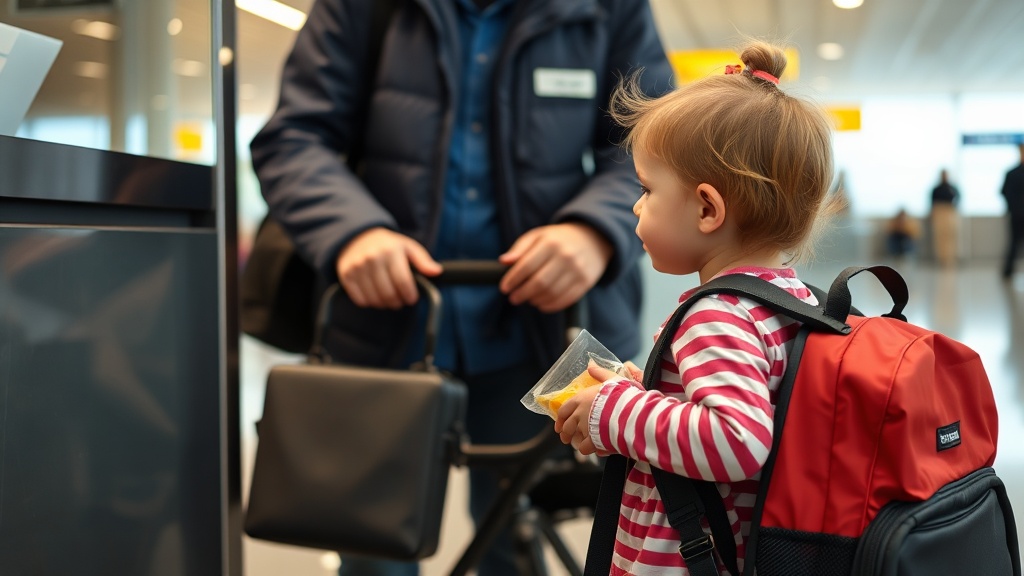
What should I pack the night before so airport security with kids stays calm?
I use a Three-Container Method at home while everyone is already tired enough:
Container 1: The “fast pass” bag
Everything that should go straight to the tray table:
- spare underlayers for each kid
- one small snack each
- wipes and sunscreen
- compact rain layer
This bag is your emergency handover box: shoes off, liquids in, belt on, done.
Container 2: The “I know this will happen” bag
What seems optional at bedtime becomes mandatory by 30 minutes before security:
- meds and prescriptions
- one extra diaper set
- water bottle with empty policy in mind
- one extra zip pouch for breastmilk or formula if needed
Container 3: The “we can postpone” bag
Everything else goes here, even if it matters to normal life:
- extra snacks for later
- extra charger cables
- toiletries that can wait 60 minutes
The point is simple: reduce decision points at the checkpoint.
TSA’s liquids rule is the one line that trips people up most. Know it before you get there: bottles and gels are constrained, and the bin is where forgetfulness gets expensive.
Read it once now: TSA liquids, aerosols, and gels rule.
How should I handle strollers and car seats without losing my sanity?
If you fly with a stroller at all, this is where 20% of families go from “organized” to “spiraling.”
TSA’s stroller/car-seat travel tips explain that local airport staff have specific handling expectations, so your setup should be airport-specific, not generic.
Use this pattern:
- Keep collapsible pieces easy to separate.
- Put all stroller straps in one outer pocket.
- Put your child’s comfort item inside the stroller pocket, not in a random backpack pocket.
The official family-travel guidance is here: strollers and car seats at security.
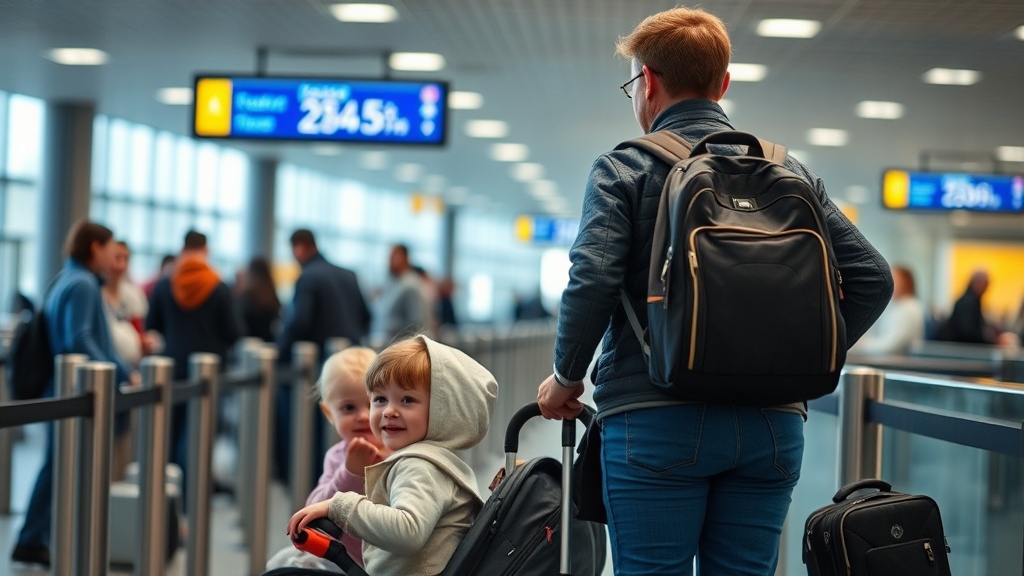
What is a realistic arrival sequence at security with kids?
I stop treating this as “a queue” and call it a sequence.
A sequence survives turbulence; a queue does not.
Sequence step 1: pre-open bags at home
You already packed, so open each bag and show exactly what goes in every pocket. This is not redundant; it’s a confidence reset.
Sequence step 2: assign a role to each kid
- Big kid scans their own small jacket.
- Younger child carries one small snack pouch.
- Parent 1 manages bins.
- Parent 2 runs shoes + outerwear.
Sequence step 3: trigger language
I use simple one-line commands: “Shoes. Bin. Boots in. Hands visible.”
Sequence step 4: move the chaos window to a neutral zone
If line time goes long, I do a 90-second bathroom/mic drop before the checkpoint where there is still access to a restroom and hand sanitizer. That usually prevents the “I’m so mad it’s now an existential event” loop.
I rate bathrooms by Meltdown Potential all the time:
- Low: short line + clean + one functional stall.
- Medium: one line, but one stall and a sink.
- High: no one can stand still, and you lose 10 minutes just to stabilize the room.
If it’s high, I delay anything that can be delayed and keep the trip moving on essentials only.
What if one child refuses instructions at the scanner lane?
This is where your tone matters more than your logic.
Try this sequence, not a lecture:
- “I see the hard part right now.”
- “One thing at a time: shoes, then shoes-on.”
- “You can stay by me or by the blue bin if you need space.”
I do not negotiate on the same instruction three times. I give one instruction, one mission, and one consequence.
For context, I use the same framework for hotel entry, rainy-day pivots, and airport bathroom panic: clear role, clear next action.
Which airport services are actually worth the money for airport security with kids?
If you’re on a tight clock and one child under 4, you can buy back a lot of bandwidth with service support.
The mistake is buying it blindly.
- If your line is already manageable, skip it and reinvest in snacks.
- If you’re already paying $200+ in parking for a delayed family hour, the added cost can be less painful than a meltdown.
For me, services matter less when systems are clear and kids have roles.
How does this fit our normal Family Ventures playbook?
Airport days are just another “wide-gap logistics” test.
If you need grounding, map this to existing workflows:
- The Rainy Day Pivot is the same template for handling surprises.
- The Arrival-Night Grocery Playbook gives the post-security recovery half.
- The Family-Friendly Hotel Checklist catches what you didn’t finish in the terminal.
What if TSA still says no and everyone is crying?
It happens. That’s when you avoid escalating and do a reset.
I use the 30-Second Reboot:
- Lower your voice for one sentence.
- Move one person to one wall and one person to one bench.
- Drink water with a snack.
- Rebuild the sequence from step 2 (roles), not step 1.
That sounds simple because it is. It works because you stop improvising and re-load one small operating system.
Which external resources should I open before the next trip?
- TSA Families Fly tips
- TSA traveling with children
- TSA stroller and car-seat screening tips
- TSA PreCheck overview
What should I do today to avoid a security meltdown?
You can do this without buying new gear and without a full life reset.
- Set out your Three-Container Method tonight.
- Pre-open one bin and set out the roles.
- Print one airport-specific stroller/car-seat rule check into your notes.
- Decide the one fallback snack plan now.
If you do exactly these four things, airport security with kids moves from “existential threat” to “annoying, but controlled.”
My Chaos Rating
Chaos Rating: 8/10 before prep, 4/10 after prep, and 2/10 when the kids own the roles.
The Win: when the line finally opens, you still have enough emotional oxygen for the rest of the trip.
FAQ (quick answers)
Should kids do the security line with both parents?
Yes, if both can keep the same cue structure. One parent usually owns the lane, the other owns the bins and the emotional reset.
What is the no-surprise rule for liquid items?
Keep formula, breastmilk, and other clearly needed liquids in one easy-to-find pouch and tell TSA you’re ready to declare before they ask.
How early should I leave for airport security with kids?
Add at least an extra 45 minutes to your typical adult timing on family travel days, and more if your trip is during peak holiday periods.