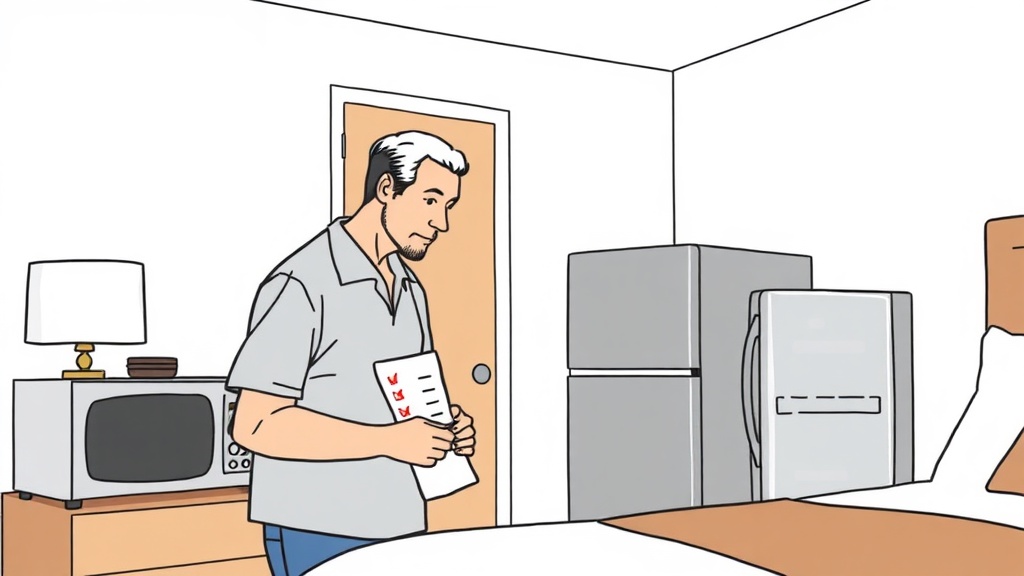
The 'Family-Friendly' Hotel Checklist You Need Before Spring Break

Listen, I've been burned enough times to write a dissertation on this. You search "family-friendly hotels [city]," you find a place with a 4.2-star rating and a little icon of a rubber duck, you pay the deposit, you pack the Tactical Snack Bag, and then you arrive to discover that "family-friendly" means they have a pool—which is closed for maintenance—and a "kids eat free" deal that applies to a menu consisting of cheese quesadillas and the existential despair of parents who forgot to pack dinner alternatives.
Spring break is approximately three weeks away. Before you hand over a non-refundable deposit on the wrong hotel, I want you to run this checklist. It takes 20 minutes. It will save you from a Level 8 on the Margarita Scale.
First: What "Family-Friendly" Actually Means to a Hotel
Let me be very direct with you: "family-friendly" is a marketing category, not a promise. A hotel earns that label by having some of the following: a pool, a rollaway cot option, a kids' menu, or enough common sense not to put the ice machine directly next to Room 214 (they all put the ice machine next to a room). It does not mean anyone at that property has ever actually traveled with a 4-year-old and thought critically about the experience.
The checklist below is what I now run before booking anything. I've sorted it from "foundational survival" to "quality of life." The first three are non-negotiable. If a hotel fails any of them, I move on.
The Non-Negotiables
1. The Microwave Situation
This is my Everest. My personal hill. If a hotel describes itself as "family-friendly" or "luxury family resort" and the rooms do not have microwaves—or at minimum, a microwave available on request—it is being actively hostile to families. A child at 9 PM who didn't eat enough dinner is not a theory. It is a certainty. And the ability to heat up the leftovers from the $14 mac and cheese or the Trader Joe's pouches I definitely packed (see: Tactical Snack Bag) is the difference between a settled bedtime and a Level 6 situation.
How to verify: Don't trust the website photos. Call the front desk and ask directly: "Do in-room microwaves come standard, or are they available on request?" If the answer is "we have a microwave in the lobby," hang up. (I'm kidding. Sort of.)
Chaos Rating bump if missing: +3 points.
2. The Checkout Time vs. Nap Schedule Problem
Most hotels have an 11 AM checkout. Your toddler's nap window is 12–2 PM. Do the math. If you're trying to enjoy the pool on your last day and you're also battling the checkout timer while wrestling a wet, overtired preschooler into a car seat in a parking garage, that is a Tactical Error that could have been avoided by asking one question: Is late checkout available, and what does it cost?
Some hotels offer late checkout free for loyalty members. Some charge $40-80. Some are "subject to availability," which means you call at 10 AM, they say "we're sold out tonight," and you are sprinting across the property with wet towels by 10:55 AM.
How to verify: Ask at booking. Get it in writing (or at minimum in the booking confirmation). Budget for the late checkout fee—it is almost always worth it.
Chaos Rating bump if not available: +2 points.
3. The Connecting Room vs. Adjacent Room Distinction
This one took me an embarrassingly long time to learn. If you need two rooms—one for the adults, one for the kids—there is a vast difference between "connecting rooms" (a door between the two rooms, accessible from inside) and "adjacent rooms" (you're next to each other, but you're walking into the hallway to check on the kids). When you're in a hotel at 11 PM trying to hear if someone's crying on the other side of the wall, adjacent does not cut it.
How to verify: When booking, ask specifically: "Are these connecting rooms with an interior door?" If they say "adjacent," that's your answer.
Chaos Rating bump if adjacent only: +2 points.
The Serious Quality-of-Life Items
4. The Pool Reality Check
The pool is on every family hotel marketing slide deck. The pool is also frequently: under construction, heated to a temperature that makes it unusable in March, open for three hours a day, requiring towel vouchers you have to get from a specific desk that closes at 6 PM, or so crowded during spring break week that it functions less as a pool and more as a slow-moving human soup.
What to ask:
- What are the pool hours?
- Is there a heated pool (for spring break in non-tropical climates, this matters)?
- Is the pool scheduled for any maintenance during my stay dates?
- Is there a towel policy, and where do I get them?
I also check recent reviews on TripAdvisor specifically filtered to the past 60 days. People are merciless about pool conditions in real time. (This is one area where I actually find TripAdvisor useful.)
5. The "Kids Eat Free" Math
Let's be very clear about what "kids eat free" means: it means one child eats free off the kids' menu with the purchase of an adult entrée. At a hotel restaurant. Where an adult entrée averages $28. And the kids' menu is four items, two of which are nuggets and two of which are pasta, and your 11-year-old is currently going through a phase where they insist they are "not a little kid" and wants to order off the adult menu.
The kids eat free deal is fine. It is not the game-changer it's marketed as. Factor it in as a small discount, not a meal plan.
The actual math I run: What is the real cost of one family dinner at this hotel's restaurant, assuming two adults and two kids? If it's over $80, I am finding a nearby grocery store and a microwave (see: Item 1) for at least one dinner.
6. The Bathroom-to-Kid Ratio
If you are traveling with two kids and you and your partner, and you have one bathroom, the morning checkout routine is going to feel like rush hour at a single-stall airport bathroom. This is not a crisis—it's manageable—but it is a thing to know in advance so you can account for it in your packing (extra toiletry bags, one person handles the kids' bathroom routine the night before, etc.).
Two-bedroom suites with two bathrooms exist at a price point that is often only $30-60 more per night than two standard rooms. For a five-night spring break trip, that's $150-300 for dramatically reduced morning chaos. That is frequently worth it. This is what I mean by the Middle-Class Splurge logic: spend the money where it eliminates friction.
7. The Noise Buffer Assessment
(Here's the internal monologue no one talks about in hotel reviews: Is this room going to be sandwiched between an elevator shaft and a room full of college students on spring break? Because if so, nobody sleeps, and an overtired family is a family running a permanent Chaos Rating of 9.)
What to request: When you call to confirm your reservation, ask to be placed on a higher floor, away from the elevator and ice machine, and not facing a pool area or parking lot. This is a totally reasonable request and costs you nothing to ask. Most front desk staff will do their best to accommodate it.
What to check: Look at the hotel floor plan (many are on the website, or you can ask). Specifically note: Where is the elevator? Where are the vending and ice machines? Is the room you're booking above the bar?
The Full Pre-Booking Checklist (Print This. Seriously.)
Here it is consolidated, because I know some of you are reading this from the carpool lane and need it fast:
- ☐ In-room microwave (or confirmed on-request)?
- ☐ Late checkout available? Cost?
- ☐ Connecting rooms confirmed (not just adjacent)?
- ☐ Pool hours + heated pool + current maintenance status?
- ☐ Checked reviews from past 60 days for pool/cleanliness reality?
- ☐ Real dinner cost math done (grocery alternative identified if needed)?
- ☐ Suite with two bathrooms vs. single-bath priced out?
- ☐ Request made for quiet floor, away from elevator/ice/bar?
The Real Cost Breakdown: What to Budget Beyond the Nightly Rate
Because radical transparency is the entire deal here, and because hotels have gotten extremely creative about padding the bill:
- Resort fee: $25-45/night at any hotel that has the word "resort" in its name, and increasingly at hotels that definitely do not count as a resort. Non-refundable. Not always in the initial price search. Check before booking.
- Parking: If you're driving to the hotel, this can be $20-45/night in urban areas. Not always listed prominently.
- Late checkout fee: Budget $40-60 if you need it.
- The actual dinner math: See above. Budget $80-120 for one family dinner at the hotel restaurant, and then make a grocery run.
- The $12 airport Ibuprofen equivalent: Whatever emergency purchase happens because you're tired and just need it. Budget $30 as a general contingency per travel day.
The Win
Here is the part that matters: the right hotel doesn't make the trip magical (nothing is magical; we've established this). What the right hotel does is reduce the number of friction points enough that when something goes wrong—and something will go wrong—you have enough reserves to laugh at it instead of sitting on the bathroom floor of a $280/night room wondering what choices led you here.
Run the checklist. Make the calls. Pay for the second bathroom if you can swing it. Keep the microwave non-negotiable.
And if you're already booked somewhere that fails items 1-3? Buy a power outlet with a USB-C port, pack the cold snacks in the good cooler bag, and download the Domino's app for night two. You'll survive. I've survived worse.
Happy spring break. The chaos is temporary. The memories (and the historical evidence photos) are forever.