The Solar Maximum is Here: A Survival Guide for Parents Considering the Northern Lights (And Why You Might Regret It)

Listen, I need to be real with you about something that's been clogging my feed lately: The Aurora Borealis. Specifically, the fact that 2026 is apparently "Solar Maximum"—a fancy way of saying the sun is throwing a tantrum and we're getting front-row seats to the light show for the first time in over a decade.
Every travel blogger and their algorithmically-optimized cousin is posting dreamy photos of green swirling skies with captions like "Once-in-a-lifetime family adventure!" and "Magic awaits!"
Can we talk about what they're NOT showing you?
The 2 AM wake-up calls. The $400 thermal snowsuits your kid will outgrow by June. The three-hour drive to "escape light pollution" while someone in the backseat asks if we're there yet. The bitter reality that your 4-year-old cares more about the hotel's continental breakfast than the actual goddamn aurora.
But—and here's the thing—I'm still going to tell you to do it. Because this is what I call a Middle-Class Splurge moment. This is where you save on the flights, skimp on the hotel lobby bar, and pour every discretionary dollar into one singular, ridiculous experience that your kids might (might) remember when they're thirty.
The Reality Check: What "Solar Maximum" Actually Means
Scientists are saying 2026 will see the most powerful Northern Lights in 100 years. The sun is at peak activity in its 11-year cycle, which means more frequent, more intense, more visible displays—even farther south than usual.
Translation for parents: You could potentially see the lights from places like Minnesota, Michigan, or even (if conditions align) the northern tier of the lower 48. You don't HAVE to fly to Tromsø, Norway and remortgage your house.
But—and this is crucial—there are no guarantees. The Aurora is not a theme park ride with posted hours. It's a weather-dependent, geomagnetically-fickle phenomenon that has made fools of far more prepared people than you.
The Chaos Factor: Why This Is Harder Than Instagram Suggests
Let me break down the actual logistics of Northern Lights viewing with children:
1. The Timing Problem
The lights don't care about bedtime. Peak viewing is typically between 10 PM and 2 AM. If you have a child who turns into a gremlin after 8 PM (I have two), you need a strategy.
The Tactical Solution: Book a Northern Lights "wake-up call" hotel or lodge. Many aurora-focused accommodations in places like Fairbanks, Alaska or Yellowknife, Canada will literally call your room if the lights appear. You sleep in your clothes. When the phone rings, you carry sleeping children to the viewing area, wrap them in blankets, and hope they open their eyes long enough to witness the spectacle.
2. The Temperature Reality
Aurora viewing happens in winter. In places where winter means business. We're talking temperatures that can hit -20°F (-29°C) or lower.
The Tactical Error to Avoid: Do not assume your "winter coat" from Columbus, Ohio is sufficient. It is not. You need base layers, mid-layers, insulated outer shells, hand warmers, toe warmers, and backup hand warmers. Budget $150-200 per person for proper cold-weather gear if you don't already own it.
3. The Patience Factor
You might stand outside for two hours in subzero temperatures and see nothing. The lights are not on demand. Your children will not understand this.
The Exit Strategy: Build flexibility into your itinerary. Plan 3-4 nights in an aurora zone. If you get a show on night one, celebrate and pivot to daytime activities. If not, you have backup chances. Do not plan a one-night "aurora hunt" with kids. That's not a vacation; that's a hostage situation.
The "Domestic Aurora" Option (The Budget Play)
Here's something the international travel influencers won't tell you: Because of this Solar Maximum, your chances of seeing the Northern Lights from the contiguous United States are significantly higher than normal.
Lower-48 Aurora Zones to Consider:
- Upper Peninsula, Michigan (Headlands International Dark Sky Park)
- North Shore, Minnesota (Split Rock Lighthouse area)
- North Dakota (Theodore Roosevelt National Park)
- Northern Maine (Aroostook County)
- Idaho Panhandle (Priest Lake area)
These locations require far less investment than Iceland or Norway, and if the lights don't show, you're still in a place with snowmobiling, hot chocolate, and reasonably priced lodging.
The Real Cost (Domestic Route):
- Gas/flights: $300-800 depending on distance
- Lodging: $120-200/night (3-4 nights recommended)
- Cold-weather gear: $600-800 (family of four)
- Food/activities: $400-600
- Total: $2,000-3,200
The "Go Big or Go Home" Option (The Splurge)
If you're going to do the full international Aurora experience, here's my honest breakdown:
Iceland (Easiest for Families):
- Pros: English widely spoken, good infrastructure, geothermal hot springs for thawing out
- Cons: Expensive as hell, weather is unpredictable, daylight hours are limited in peak aurora season
- Real Cost: $6,000-10,000 for a family of four (5 days)
Norway (Tromsø Region):
- Pros: Excellent aurora infrastructure, dog sledding, Sami culture experiences
- Cons: Seriously expensive, requires more complex logistics
- Real Cost: $7,000-12,000 for a family of four
Fairbanks, Alaska (The Sweet Spot):
- Pros: US currency, excellent aurora viewing odds, hot springs nearby, easier logistics
- Cons: Still requires long flights for most Americans, cold as heck
- Real Cost: $4,000-6,000 for a family of four
The Wide-Gap Challenge: Making It Work for Ages 4 and 14
If you're like me and parenting kids with a seven-year age gap, the Aurora presents a unique problem: Your teenager wants to stay up until 2 AM scrolling TikTok anyway, but your elementary kid needs 10 hours of sleep or the next day is ruined.
The Solution: Divide and conquer. One parent takes the night shift with the older kid(s). The other stays with the younger ones and gets the wake-up call if it's truly spectacular. Rotate nights. Everyone gets a turn, no one is permanently traumatized.
The Meltdown Map: Bathroom & Exit Strategy Notes
If you're aurora chasing, you need to know where the heated bathrooms are. Standing outside at midnight with a child who "needs to go" is a special circle of hell.
What to look for:
- Heated aurora viewing domes/yurts (available in Fairbanks and Tromsø)
- Lodges with outdoor hot tubs (the only way to survive waiting)
- Clear sightlines to parking so you can bail if someone is miserable
My Honest Verdict
Is chasing the Northern Lights during Solar Maximum worth it with kids? Maybe.
It's not relaxing. It's not "seamless." It's a gamble with real money and real sleep deprivation on the line.
But here's the thing: Most of our family vacations blur together. The beach trips, the theme parks, the "kid-friendly" resorts—they start to feel like the same experience in different zip codes.
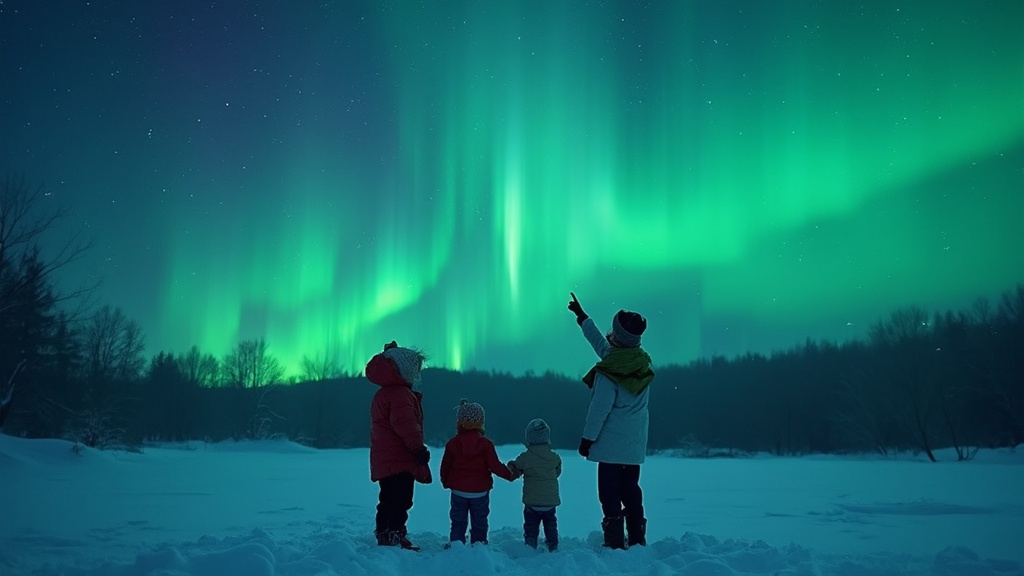
Standing in a frozen field at midnight, holding your breath as green ribbons of light dance across the sky while your children (miraculously) stand still and stare upward in wonder? That's the memory that sticks. That's the story they'll tell at their wedding rehearsal dinner someday.
It's the kind of ridiculous, ambitious, possibly-ill-advised adventure that reminds you—and them—that the world is bigger than the carpool lane.
The Win: We did Fairbanks in late February. Night one: nothing. Night two: a faint green smudge that the kids politely pretended to appreciate. Night three: the sky exploded. Green, purple, ribbons that moved like they were alive. My 11-year-old actually gasped. My 4-year-old fell asleep in my arms five minutes later, but he saw it first. That's the win. The three nights of patience, the $200 in hand warmers, the tactical planning—it all paid off in one moment of genuine wonder.
If you're going to do this, do it this year. Solar Maximum won't come again until 2037, and by then your kids will be adults who roll their eyes at your travel suggestions.
Plan the logistics. Pack the snacks. Lower your expectations. And if the sky lights up?
That's Middle-Class Magic.
Chaos Rating: 8/10 (High risk, high reward)
Margarita Level: I-Need-A-Margarita (and possibly a heating pad)
Wide-Gap Compatibility: Moderate (requires strategic planning)