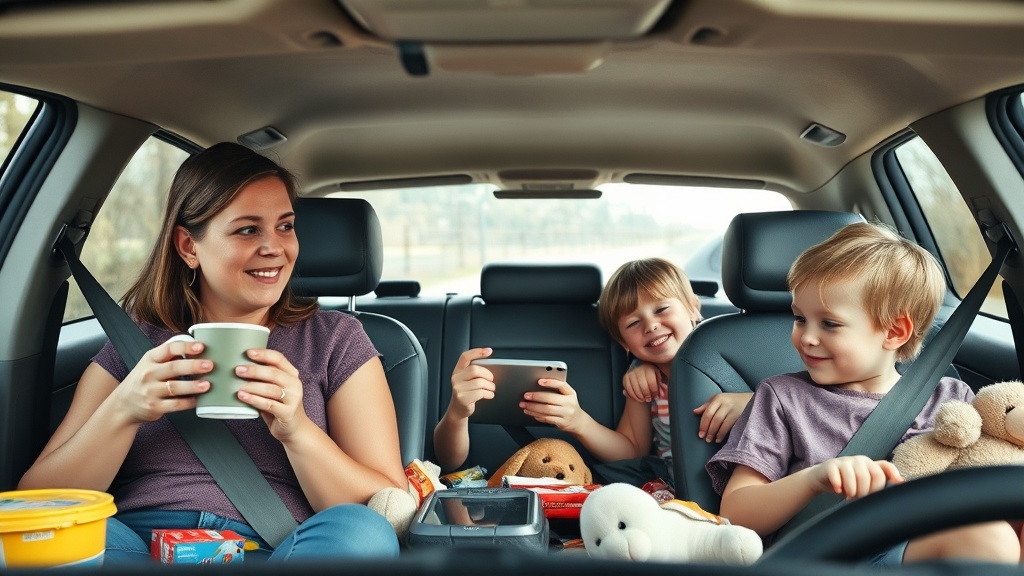
The Real Adventure: How Moms Are Redefining Travel (And Why We're Not Apologizing)

There is a version of this post where I tell you about the mom who hiked to Machu Picchu with a baby on her back and a toddler on her husband's and arrived at the summit looking like a L.L.Bean catalog. She probably exists. She is not who I'm writing for.
I'm writing for the mom who sat on a Denver airport bathroom floor in 2019 — that was me, by the way — crying into a 60-page color-coded travel spreadsheet while her 2-year-old banged on the stall door and her 9-year-old stood outside asking if they were "going to miss the plane again." I had laminated tabs. I had contingency plans for my contingency plans. I had completely lost the thread of why any of us were doing this.
International Women's Day is in two days. Everyone's going to post about "women who inspire." And yes, fine, the mountaineers and the solo trekkers and the women who quit their jobs to van-life across Patagonia are remarkable. But I want to talk about a different kind of revolution — quieter, messier, happening in minivans and airport gate areas and beach condo parking lots across North America.
Moms are redefining what "adventure" means. And we're not asking permission.
The Old Definition Was Never Ours
Let's be honest about where "adventure travel" came from as a concept: men. Specifically, men with sabbaticals, trust funds, or both, who had the luxury of treating discomfort as a character-building exercise because someone else was handling the logistics of daily life.
The adventure travel industry was built on a fantasy: that real experience requires extremity. You had to go far. You had to go uncomfortable. You had to come back with a story that started with "there was no running water, but—"
That definition got dressed up in Instagram aesthetics around 2013 and handed to families like a gift. Except it wasn't a gift. It was a performance assignment.
Suddenly "good family travel" looked like: obscure destination, minimum 7-day trip, activities so enriching they'd show up in college essays, photos that demonstrated both adventure AND togetherness AND that your children were well-dressed. The invisible labor of making all that happen — the research, the bookings, the packing lists, the snack logistics, the emotional preparation of small humans who do not care about your itinerary — fell disproportionately on mothers.
We got the spreadsheet. Someone else got the story credit.
The Quiet Rebellion (It Sounds Like a 7-Year-Old Saying "I'm Tired")
Here's what I've watched happen in the family travel community over the last few years, and it's genuinely beautiful: moms started saying no.
Not dramatically. Not with manifestos. Just... quietly, practically, sanity-preservingly no.
The mom who skipped the "Instagram must-do" waterfall hike because her kid fell asleep in the car and she thought: you know what, he looks peaceful, let's just sit here for twenty minutes. She took a picture of his eyelashes in the afternoon light instead. That's the photo she still has on her phone.
The mom on a road trip through the Smokies last spring — I heard this one in a Facebook group and it has lived in my head rent-free — who, facing a car full of increasingly unhinged children at hour six, pulled into a gas station, bought four slices of sad pepperoni pizza wrapped in plastic, and announced to her family: "This is dinner. This is an adventure. We are thriving." Her kids talk about the gas station pizza more than the cabin they rented.
The mom who told me, completely without irony, that she now measures a successful trip by one metric: "Did everyone survive without crying in the parking lot?" Not miles covered. Not landmarks photographed. Not moments captured. Parking lot tears. Zero-parking-lot-tears is a W.
These are not women who failed at adventure. These are women who upgraded the definition.
The Economics of "Good Enough" (Spoiler: It's Actually Better)
Here's the part nobody talks about: the old adventure model was expensive. Not just in money — in everything.
When you're performing a vacation instead of experiencing one, you spend money defensively. You book the "iconic" restaurant because the alternative is admitting you didn't do it right. You push through the third museum because you paid for the city pass. You stay until the park closes because you are getting your money's worth, so help you, even though your 4-year-old has been melting down since 2 PM and you've been carrying her for the last forty-five minutes.
Moms who've stepped off the performance treadmill spend differently. The budget goes toward things that actually matter to their family — the extra night so nobody has to rush, the short flight instead of the twelve-hour drive, the boring familiar restaurant the kids love instead of the adventurous one that becomes a trauma.
The return on "good enough" is legitimately better. You come home less broke and less fried. Your kids remember things they actually enjoyed. You have the bandwidth — emotional, financial, physical — to do it again.
And you do it again, because it was fun instead of a crucible.
What This Has To Do With Women's Day
Everything.
The redefinition of adventure travel isn't just a parenting style shift. It's women rejecting a standard that was never designed with them in mind, and building something new in its place. It's happening without press releases or trend pieces. It's happening in group chats and parking lots and five-star reviews that say "the beds were comfortable and my kids actually slept."
For a long time, mothers have been the primary architects of family travel. Travel industry surveys — including data from MMGY Global and the Vacation Confidence Index — have consistently put women as the lead trip-planner in the majority of households, with figures ranging from 70 to 85 percent depending on the study. The pattern is consistent enough that it's not seriously disputed. But for a long time, we were planning toward someone else's vision of what a trip should be. We were execution engines for an idea that wasn't ours.
What's changing is the idea.
The new adventure is: connection over competition. Spontaneity over spreadsheets. Coming home with your dignity intact and maybe one or two decent stories. A standard designed by the people actually doing the work, for the actual humans actually on the trip.
That's not settling. That's not lowering the bar. That's finally raising the right bar.
Your Permission Slip (You Didn't Ask, But Here It Is Anyway)
You don't need to justify your family's version of adventure to anyone.
Not the relatives who ask if you "really got to experience the culture." Not the Instagram algorithm. Not the ghost of my laminated Denver spreadsheet.
If your kid's best memory from spring break is a gas station pizza in the rain — that's a win. If you skipped the thing everyone said you had to do because someone was tired — that's good parenting. If your trip looked nothing like the Pinterest board and everything like your actual family — that's the point.
The most adventurous thing a mom can do, I've come to believe, is decide that joy is the destination. That getting there — getting everyone there, more or less intact, with stories you'll still be telling in ten years — is the whole entire point.
We're redefining adventure. We've been doing it quietly for years.
This International Women's Day, I just wanted to say it out loud.
You're doing it right.
Happy International Women's Day to every mom who has ever eaten Goldfish crackers for dinner in a hotel room and called it an adventure. You are my people.