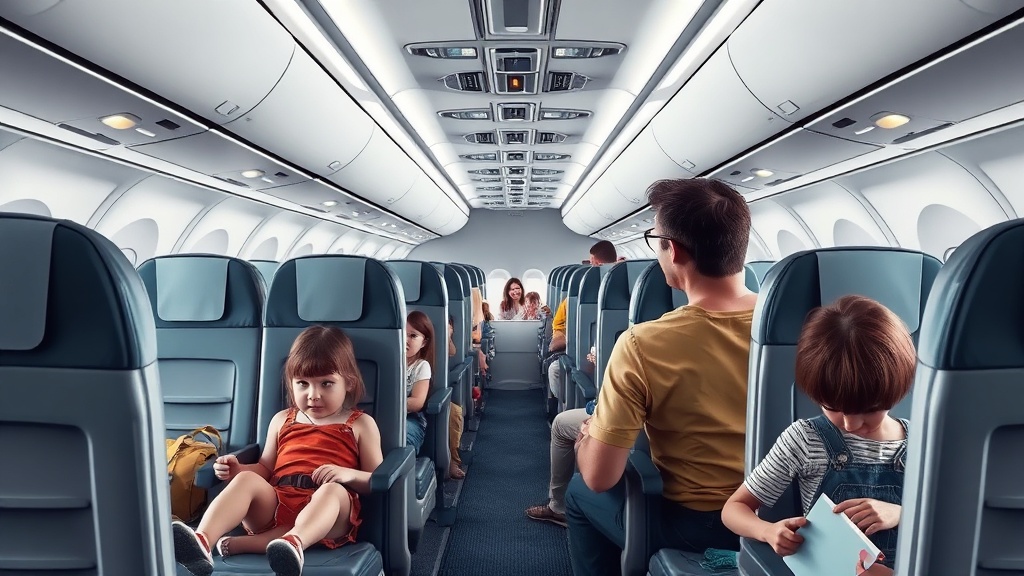
The Family Seat Trap: How Airlines Turned Scared Parents Into a Revenue Stream (And How to Fight Back)

Listen, I need to talk to you about something that almost sent me back to therapy. It was February, I was booking spring break flights for four people—two adults, a 4-year-old, and an 11-year-old—and I found a fare that actually worked. I clicked through to the seat selection screen. And then I watched as every single available seat lit up with a little lock icon and a price tag between $28 and $67. Per person. Per segment.
To sit together. On a two-hour flight. With a preschooler I cannot legally leave unaccompanied in Row 27.
This is the Family Seat Trap, and if you're booking spring break flights right now, you're about to walk face-first into it.
What's Actually Happening (And Why It's Deliberate)
Here's the mechanics of the scam, explained plainly so you can be appropriately furious:
Airlines have discovered that families are economically coercive customers. You cannot put your 4-year-old in Seat 22F while you sit in 9B. That's not a preference—that's a supervision requirement. Airlines know this. Their revenue management software knows this. Which is why budget fare classes ("Basic Economy" on most carriers) are specifically designed to block all advance seat selection, then offer it back to you as a premium add-on during checkout.
The pattern looks like this: The cheap fare shows up on Google Flights. You click. The base fare is great. Baggage fees appear. Fine. Then: "Select your seats for $34 each." For a family of four on a round trip, that's an extra $272 in seat fees alone. The "deal" just evaporated.
(The fact that they've calculated this to be just under the "I'm too annoyed to continue" threshold is not an accident. That is A/B tested psychological exploitation. I said what I said.)
The Rule You Need to Know
The Department of Transportation has been on airlines about this. Under significant regulatory pressure, most major U.S. carriers have adopted policies stating they will seat children 13 and under adjacent to an accompanying adult at no additional charge—even on Basic Economy fares. United, American, Alaska, and Frontier have all made version of this commitment publicly.
The catch: they don't advertise this on the checkout screen. You know what they advertise on the checkout screen? The $34 seat fee. You are expected to just pay it and not know your rights.
So here's your first Tactical Tool: Call the airline directly before purchasing any seat add-ons. Tell them you're traveling with a child under 13 and ask to be seated together at no charge. Most agents will do it. Some will push back. Stay calm, invoke the policy, ask for a supervisor if needed. The seats exist. They're just hiding them behind a paywall they're not actually entitled to charge you.
The Escape Routes (In Order of Reliability)
I've tested all of these. Here's what actually works:
1. Book Directly With the Airline (Never Third-Party for Families)
Booking through Expedia, Kayak, or a third-party site cuts you off from the airline's seat inventory management system. When something goes wrong—and with family travel, something always goes wrong—you're stuck in a three-way loop of hold music between the OTA and the carrier. Book directly. Always.
2. Check In at Exactly T-minus 24 Hours
Most airlines release a block of free seats at the 24-hour check-in window. Set an alarm. Open the app at exactly the 24-hour mark. On many carriers, you can grab free adjacent seats at this point that weren't available (for free) before. This works more reliably on Southwest (which has no assigned seating at all—it's a boarding group game) than on carriers with locked fare classes.
3. Southwest Deserves a Separate Conversation
Listen, I know Southwest gets complicated now that they've moved to assigned seating. (RIP the open-seating chaos that I had somehow trained myself to navigate like a heat-seeking missile for exit row middle seats.) But historically, Southwest's model meant families could board in the "family boarding" group between A and B—which often got you four seats together without paying anything extra. Check the current Southwest family boarding policy before you write them off.
4. Mid-Cabin Middle Seats Are Leverage
Here's a slightly dark strategy that works: on airlines that do have some free seat selection even on basic economy, grab the middle seats in your row on purpose. Nobody wants the middle seat. If you're in 18B and 18E (the two middles in a 3-3 configuration), the airline has strong incentive to seat your family together in that row because otherwise they're selling window and aisle seats next to unoccupied middles, which makes no one happy. This doesn't always work, but it's a zero-cost lever.
5. Status Passengers and Loyalty Points
If you're going to fly this airline twice a year for the next decade anyway, a co-branded credit card with an annual fee might actually math out. Companion certificates, priority boarding, complimentary seat upgrades—these add up when you have a 4-year-old who requires physical containment on an aircraft. I'm not normally a points-maximizer (that's James's department), but for families who travel even semi-regularly, loyalty program math is legitimate.
The Chaos Factor Rating
Navigating Basic Economy Family Seating: 7/10 on the Margarita Scale.
Not because it's hard once you know the rules—it's actually manageable. But because you're fighting against systems specifically designed to extract money from you while you're tired, traveling with children, and just trying to click through to the confirmation page. The stress is structural. It's manufactured. And it works on most people, which is why airlines keep doing it.
The Real Cost Breakdown: Spring Break Flight Reality Check
Let me show you what a "budget" spring break flight actually costs a family of four if you don't know what you're doing:
- Base fare (2 adults + 2 kids, round trip): $620
- Checked bag, 1 per adult (round trip): $140
- Seat selection to sit together: $272 (if you pay without fighting it)
- Carry-on fee if Basic Economy: $120
- Airport snacks because nobody packed a Tactical Snack Bag: $60
- Ibuprofen in Terminal C because you're already exhausted: $12
- Total: $1,224 for a "budget" $620 fare
Now here's what it costs if you fight the seat fee, pack carry-ons correctly, load the Tactical Snack Bag before you leave the house, and book directly:
- Base fare: $620
- Checked bag (1 per adult, round trip): $140
- Seat selection: $0 (called the airline, got it handled)
- Carry-on: $0 (packed within policy)
- Snacks from home: $18
- Ibuprofen from CVS the night before: $4
- Total: $782. You just saved $442.
$442 is a really nice dinner. Or a morning kayak tour. Or the difference between a stressful trip and a "Middle-Class Splurge" on something that actually creates a memory.
The Bathroom Rating: Airport Edition
Since we're already here: if you're connecting through a major hub, here's my family-relevant intel. O'Hare Terminal 3 has solid family restrooms near gate H1 with changing tables that don't look like they were installed in 1987. Atlanta's Concourse B has a family room past security that's actually soundproof enough to execute a meltdown in privacy. Dallas Fort Worth's Terminal D—specifically around gate D22—has a nursing lounge that doubles as a quiet space for overwhelmed toddlers. File these away. You'll need them.
The Win
The first time I called an airline and said "I need adjacent seating for my child under 13 at no additional charge per your policy"—and they said "Of course, let me pull up your reservation"—I felt like I'd unlocked a cheat code. Not because I'd beaten some system, but because I'd stopped assuming the checkout screen was the whole story.
Spring break flight booking is a Tactical Operation, not a passive scroll. Know your rights, call the airline, and stop paying $272 for the privilege of not losing your child at 30,000 feet.
Now go book the flight. The seats are there. You just have to ask for them.
Got a airline seat horror story? Or a hack that actually worked? Drop it in the comments — I'm building a database of what works on which carrier.