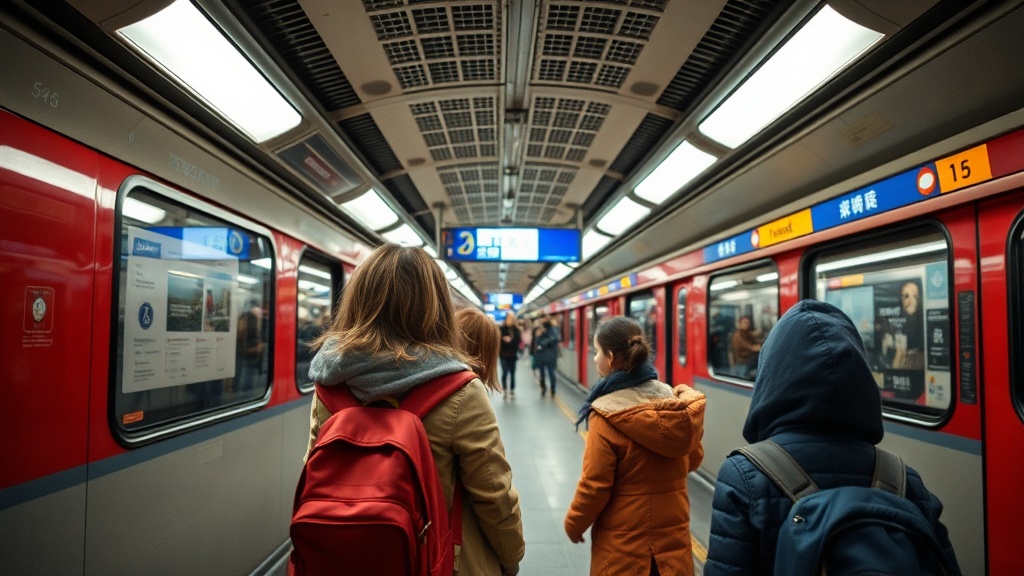
How to Teach Your Kids to Navigate a Foreign Subway System

What You Will Learn
This guide provides a tactical framework for teaching children how to navigate complex, foreign subway systems safely and independently. You will learn how to prepare them before you leave home, how to assign specific roles during the transit process, and how to manage the inevitable sensory overload that occurs in high-density urban environments like Tokyo, London, or New York City.
Phase 1: The Pre-Trip Simulation
Do not wait until you are standing in front of a glowing digital map in a crowded station to explain how a subway works. By then, the noise, the smells, and the sheer volume of people will already be triggering a fight-or-flight response in your children. Preparation starts at the dining room table.
Use Digital Visual Aids
Before your departure, pull up Google Maps or the specific transit app for your destination (such as the Citymapper app, which is excellent for European and major US cities). Show your children the lines, the colors, and the transfer points. If you are going to London, show them the different colors of the Underground lines. If you are going to Tokyo, show them the distinction between the JR lines and the Tokyo Metro. Visual familiarity reduces the "fear of the unknown" that leads to meltdowns.
The "Dry Run" at Home
If you live in a city with a transit system, take a low-stakes trip. Let them practice the mechanics of tapping a card or a phone against a sensor. If you don't live near a transit system, use a tabletop game or a simple drawing. Create a "map" on a piece of paper and have them "drive" a toy car along a specific colored line to reach a "destination" (the kitchen or the living room). This turns a complex logistical system into a predictable game.
Phase 2: Assigning Strategic Roles
In a high-stakes environment like a subway station, a child who is "just following" is a child who is easily overwhelmed. To keep them engaged and focused, assign them a specific "job." This gives them a sense of agency and keeps their brain in an analytical mode rather than a reactive one.
- The Navigator: This child is responsible for watching the digital displays or the station announcements. Their job is to alert the group when the next train is arriving or when the current train is approaching their stop.
- The Signage Scout: This child looks for the exit numbers or the specific platform signs. In a station like Shinjuku in Tokyo, there are hundreds of exits; having a child look for "Exit A1" keeps them looking up and forward rather than at their feet.
- The Ticket Monitor: This child is in charge of ensuring everyone has their transit card (like an Oyster Card in London or a Suica card in Japan) ready for the turnstile.
By giving them these roles, you are moving them from the role of a passive passenger to an active participant. This is a crucial skill for building confidence in unfamiliar environments.
Phase 3: Managing the Sensory Environment
Subways are sensory minefields. There are screeching brakes, flashing lights, crowded platforms, and unexpected smells. For many children, this isn't just "annoying"—it is physically overwhelming. You must equip them with tools to manage this input.
The Sensory Toolkit
Always carry a small kit of sensory regulation tools. This should include high-quality noise-canceling headphones or even simple earplugs. If the roar of the train becomes too much, the headphones provide a physical barrier. Additionally, keep a fidget toy or a small, tactile object in their pocket. This provides a grounding sensation when the environment feels chaotic.
The "Safe Word" and Exit Strategy
Establish a clear, non-negotiable signal for when a child feels overwhelmed. This shouldn't be a long discussion; it should be a single word or a hand gesture. If they use the signal, it means you move to a "quiet zone"—perhaps a bench on a less crowded platform or a corner of the station—to reset. Knowing there is an "out" actually helps many children stay calmer because they don't feel trapped by the environment.
When you are managing these transitions, remember that physical needs often dictate emotional responses. Always have a dedicated snack bag ready for these moments. A small piece of fruit or a protein bar can be the difference between a minor sensory overload and a full-blown transit meltdown.
Phase 4: Safety and Boundaries
In a foreign subway, the rules of engagement change. You cannot rely on the same "stay within arm's reach" rule that works in a quiet park. You need more formal protocols.
The "Anchor" Technique
When the station is crowded, teach your children the "Anchor" technique. This involves holding onto a specific part of your clothing (like a backpack strap or a belt loop) or a physical object, like a sturdy stroller handle. This provides a constant physical connection to you without requiring constant verbal instructions, which can be lost in a noisy station.
The Information Card
Do not rely on your child's memory of your phone number or hotel address. Create a physical, laminated card that stays in their pocket or is attached to their clothing. This card should include:
- Your full name.
- The name and address of your hotel (in both English and the local language).
- Your mobile phone number (with the country code).
- A specific "if lost" instruction (e.g., "Find a station employee in a uniform").
Phase 5: The Post-Transit Debrief
Once you have successfully navigated the system and reached your destination, do not just move immediately to the next activity. Take five minutes to decompress. This is where the actual learning is solidified.
Ask them questions about their "job." "How did you do as the Signage Scout today? Did you see the sign for the Green Line?" or "What was the loudest sound you heard on the train?" This helps them process the experience and turns a stressful event into a successful mission. If they struggled, treat it as a data point rather than a failure. "The station was really loud today, wasn't it? Next time, let's make sure we have the headphones on before we go down the stairs."
By treating transit as a skill to be learned rather than a chore to be endured, you are teaching your children much more than just how to ride a train. You are teaching them how to navigate the world with curiosity and competence, even when the environment is loud, fast, and completely foreign.
Steps
- 1
Introduce the Concept with Maps
- 2
Assign a Specific Role
- 3
Practice Visual Recognition
- 4
Establish a Safety Boundary